
Updated
|
Charter Schools Produce More Graduates than Public Schools
Studies show that graduation rates at charter schools outpace graduation rates at public schools. Learn how charter schools have been able to improve graduation rates, and the positive effects charter schools have on students’ lives in the long-term.

The ideas behind the development of charter schools began in the 1950s. However, credit for beginning the charter school movement generally goes to former American Federation of Teachers President Albert Shanker. Shanker called for reform to public schools in the late 1980s that inspired states to pass legislation permitting the establishment of charters. Minnesota took the lead in 1991, creating the nation’s first legislated charter school, which opened the following year.

The charter school movement was borne out of the nation’s desire to improve education. This has long been a point of emphasis in our country and is often a hallmark of presidential debates and congressional action. However, determining the best way to prepare the country’s youth for post-secondary education and the workforce can sometimes be difficult to do. Parents have many options for their child’s education, including charter schools, traditional public schools, private schools, magnet schools or homeschooling. But when it comes to the debate between charter schools and public schools, recent data collected by Mathematica Policy Research reveals that charter schools seem to be doing a better job of graduating students and preparing them for life after high school.

This video compares charter and magnet schools.

Educational Benefits

According to Mathematica, the graduation rate at charter schools is between 7-11 percent higher than public schools in the same area. Even for at-risk students, who may not have the financial,

. . .read more

Changing Demographics Will Alter the Diversity of Public Schools

Updated
|
Changing Demographics Will Alter the Diversity of Public Schools
Uncover the projected changes in enrollment among diverse ethnic groups and the challenges state education systems face in meeting growing financial demands amidst increasing enrollment

Over the last 60 years, American public schools have become more and more diverse, with various ethnic and racial groups comprising a significant percentage of total enrollment. However, according to new data released by the National Center for Education Statistics (NCES), the diversity of public schools in this nation will change drastically over the next decade and appear much differently than today.

The Numbers

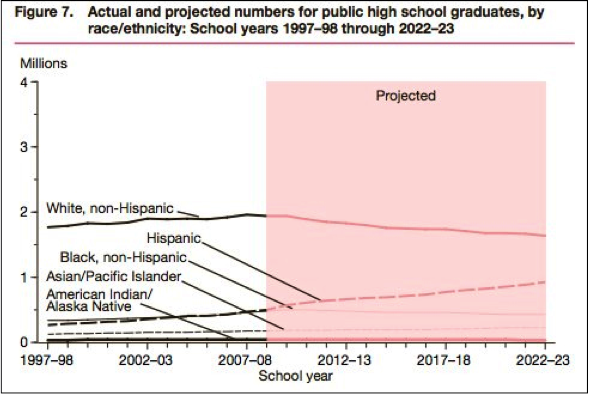
The number of white students enrolled in public schools has been falling for years. According to the NCES, between 2000 and 2010, white enrollment decreased from 61 percent to 52 percent of the total public school population. At the same time, the number of Hispanic students increased from 16 percent to 23 percent of total enrollment. This was a trend seen throughout the country over that timespan, with schools in the South and the West seeing the largest Hispanic enrollment increases of any region.

Graph from Huffington Post

The 2014 data released by the NCES shows that this trend has continued since 2010 and will continue for the foreseeable future. Through the 2022-2023 school year, the number of white students graduating is projected to decline by another 16 percent. A 14 percent decrease in the number of black students and a 29 percent decrease in the number of American Indian and Alaskan Native students that graduate from public high schools is expected as well. Conversely, other minority groups are expected to show

. . .read more

Sobering Teen Suicide Numbers Prompts Action by Schools

Updated
|
Sobering Teen Suicide Numbers Prompts Action by Schools
With rising numbers of suicide amongst children and adolescents, public school districts are taking steps to ensure that all students feel safe, welcome and accepted.

The teen suicide rate in the United States has tripled since the 1960s. Suicide is currently the third leading cause of death among adolescents, and the second leading cause of death among college students. Although suicide is highly preventable, with clearly identifiable warning signs, it continues to occur in many communities across the nation. In fact, in February and March 2014, ten New York City public school children took their own lives.

The Numbers

According to the Centers for Disease Control, each year, approximately 4,600 youth between the ages of 10 and 24 take their own lives. The vast majority of suicides are carried out via firearm or suffocation. However, it isn’t just deaths by suicide that are part of the issue. Nearly one-fourth of American high school students report thinking seriously about suicide, 13 percent report having a plan, and 8 percent report having actually attempted suicide in the last 12 months. That translates to well over 150,000 emergency room visits by children who have injured themselves as part of an attempt at taking their own life.

This video was created to promote the prevention and awareness of teen suicide.

It is well documented that boys are much more likely to die as a result of suicide. However, girls are much more likely to attempt taking their own life. In addition to these gender differences, ethnic and cultural differences also

. . .read more

10 Best SAT Prep Methods

Updated
|
10 Best SAT Prep Methods
Discover 10 expert SAT prep tips to help students improve scores, build confidence, and prepare effectively for the digital SAT in 2026.

Like it or not, the SAT is still an important opportunity for students to prove themselves to college admissions committees across the country. While many colleges remain test-optional in 2026, strong SAT scores can still strengthen applications, support scholarship opportunities, and provide another way for students to demonstrate academic readiness.

If you want to be at the top of your game, you need to develop an effective strategy to prepare. We spoke with some of the top experts in college admissions and test preparation to find out more about the best ways to prepare for the SAT.

1. Start Reading

If you have a lot of time to prepare, the first step is get reading. Richard Bernstein, Executive Director of Huntington Learning Center in Cherry Hill and Turnersville, New Jersey, says this is crucial.

"If you have a year to prepare, read, read, and read some more."

Reading remains one of the most effective ways to improve comprehension, vocabulary, and analytical skills. Students interested in strengthening their broader academic preparation may also benefit from learning about how public schools prepare for college in high school.

2. Create a Balanced Study Regimen

Build a study pattern that will get you ready for the test. Students can effectively study in a group, one-on-one sessions, or by themselves. No matter what you do, however, make sure you don't overload and always keep a reasonable study-life balance.

Setting goals is only useful if they are realistic. The best way to

. . .read more

Public School Review Diversity Report: Which States Have the Most Diverse Public Schools?

Updated
|
Public School Review Diversity Report: Which States Have the Most Diverse Public Schools?
Which states have the most diverse public schools? We analyze our data to find how much diversity truly exists on public school campuses. Learn about the varying levels of school diversity in regions around the nation, as well as the benefits derived from ethnic diversity in schools.

American public schools have made tremendous progress since the Supreme Court declared school segregation unconstitutional in Brown v. Board of Education. Schools throughout the nation are more diverse than ever before as a result of desegregation, immigration of people to this country, and emigration of citizens from one region of the nation to another. Sixty years after the Supreme Court’s decision, schools in Alabama, Mississippi, Georgia and other southern states where segregation was once so prominent have shown great gains in diversity.

But which states have the most diverse public school campuses? We collected data and analyzed the numbers to develop an original list illustrating how much diversity truly exists in each state’s public schools.

Diversity Scores of Public Schools

To equally compare the diversity of public schools in our country, we mined student population data and calculated diversity scores at the school, town, county and state levels.

While “diversity” commonly refers to the presence of minorities, we were interested in understanding the presence of more than one ethnic group on campus. For example, while theLos Angeles Unified School District has many schools that have 90% or more Hispanic students on campus, this would be considered a homogenous school, rather than a diverse one.

As such, our formula determines the likelihood that any two students are from different ethnic groups. Scores closer to 1 indicate greater diversity, while scores closer to 0 indicate lesser diversity.

When examining the various levels of scoring, school-level scores are

. . .read more

Recent Articles

When “Free Public School” Still Isn’t Free
Discover the hidden costs of public school in 2026, from supplies and fees to transportation, technology, and extracurricular expenses.
What a District Budget Cut Means for Your Child's School Experience
Learn how district budget cuts can affect class sizes, programs, staffing, transportation, and your child's daily school experience in 2026.
School Closure Risk: What Parents Should Check Before Moving
Learn how parents can assess school closure risk before buying or renting in a district, using enrollment, funding, and boundary data.