
Updated
U.S. Public vs. Private Schools Guide 2025
A clear, up-to-date 2025 guide comparing U.S. public and private schools—tuition, funding, outcomes, policy trends, and expert insights for families and educators.

U.S. Public vs. Private Schools: 2025 Guide

Choosing between public and private schools remains one of the biggest decisions for U.S. families—and in 2025, the landscape continues to shift. This guide offers a fresh look at how public and private K–12 schools compare today, with up-to-date tuition figures, policy trends, and practical insights for students, parents, and educators.

1. Funding & Tuition

Public Schools
Public schools remain tuition-free for in-district students, funded by a mix of local, state, and federal dollars. According to the National Education Association, inflation-adjusted per-student spending for public schools rose to $17,367 in the 2024–25 school year.
Federal grants remain important: in fiscal 2024, the U.S. Department of Education awarded more than $150 billion for K–12 programs, including Title I and special education. (Pew Research Center)

Private Schools
Unlike public schools, private schools charge tuition—often depending on type and location. For the 2025–26 school year, the national average private school tuition is about $14,999, with elementary schools averaging $14,018 and high schools averaging $17,954.

In more elite or independent settings, the cost is far steeper. According to Bloomberg, day-school tuition rose to approximately $49,284 in 2025, while boarding schools averaged $73,080 amid inflationary pressures. (Bloomberg)

These costs contrast sharply with public school funding, though public dollars still underpin much of K–12 education.

2. Enrollment & Demographics

Public Schools
Public schools continue to serve the bulk of U.S. students. While charter schools have grown,

. . .read more

Special Education Services in Public Schools, Rights and Resources

Updated
|
Special Education Services in Public Schools, Rights and Resources
Learn how special education services in public schools work, student rights, evaluations, IEPs, and parent resources for 2025.

Special Education Services in Public Schools: Rights and Resources Explained

Special education services in public schools play a critical role in ensuring that students with disabilities receive the support they need to thrive academically and socially. Federal law requires every district to provide special education services in public schools that meet each child’s unique needs, and parents often navigate a complex system of evaluations, plans, and programs to secure these supports. This guide explains how special education services in public schools work in 2025, outlines student and parent rights, and highlights the most current resources available.

Target keyword used throughout: special education services in public schools.

Understanding the Legal Framework Behind Special Education Services in Public Schools

Special education services in public schools are governed primarily by the Individuals with Disabilities Education Act, which guarantees eligible students a Free Appropriate Public Education. IDEA requires public districts to deliver special education services in public schools based on individualized needs rather than a predetermined program. Parents can read more about public school rights through resources such as the U.S. Department of Education’s IDEA guidance.

Other laws that shape special education services in public schools include:

  • Section 504 of the Rehabilitation Act

  • The Americans with Disabilities Act

  • Every Student Succeeds Act requirements for inclusive access

Together, these laws ensure that special education services in public schools remain accessible, equitable, and tailored to student needs.

How Eligibility for Special Education Services in Public Schools Is Determined

Districts must evaluate any student

. . .read more

Equity and Access in Public Schools in 2025

Updated
|
Equity and Access in Public Schools in 2025
Explore how equity and access in public schools shape opportunity gaps and what districts can do to address disparities.

Equity and Access in Public Schools: Addressing Disparities in Opportunity

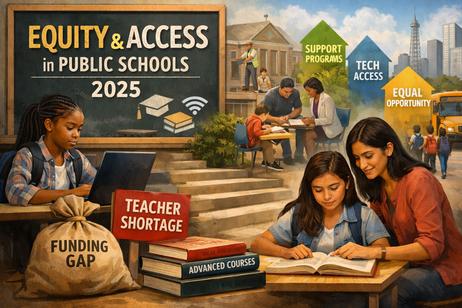
Equity and access in public schools remain central to national conversations about educational fairness, community investment, and long-term student success. As districts confront enrollment shifts, staffing shortages, and widening achievement gaps in 2025, families want to understand how equity and access in public schools directly shape academic outcomes and life opportunities.

This article examines equity and access in public schools across funding, instruction, technology, and student services. It also explores policy challenges and solutions that districts are using to reduce opportunity gaps. Throughout the discussion, we return to one guiding issue: how equity and access in public schools affect every child’s ability to learn, grow, and reach their potential.

Why Equity and Access in Public Schools Matter

Equity and access in public schools ensure that student success is not predetermined by ZIP code, income level, or family background. Instead, all students receive meaningful opportunities to thrive academically and socially.

Families increasingly evaluate districts based on their commitment to equity and access in public schools. They analyze resources such as Public School Review to understand how different systems address disparities in opportunity.

Core components of equity and access in public schools include:

  • Fair allocation of funding and staffing

  • High quality curriculum and instruction

  • Accessible support services for multilingual learners and students with disabilities

  • Safe and inclusive learning environments

  • Consistent access to technology, enrichment, and advanced coursework

Districts that invest in equity and access in public schools create stronger academic foundations,

. . .read more

How School Zoning Shapes Property Values and School Quality

Updated
|
How School Zoning Shapes Property Values and School Quality
Learn how school zoning affects property values and public school quality, plus 2025 insights for families evaluating neighborhoods.

How School Zoning Affects Property Values and Public School Quality

Understanding how school zoning affects property values and public school quality is essential for families navigating housing decisions. In 2025, zoning boundaries continue to influence neighborhood demographics, long–term home equity, and the academic strength of local schools. Whether a family is selecting a new home or an educator is evaluating community demand, the connection between zoning and school outcomes shapes nearly every part of the public-education landscape.

This article explains how school zoning affects property values and public school quality through clear examples, current research, and practical considerations for parents. It also highlights the policy debates surrounding attendance boundaries and provides tools for comparing school options.

Throughout the discussion, the focus remains on the central question: how school zoning affects property values and public school quality across different communities.

Why Zoning Matters in Public Education

School zoning assigns students to specific campuses based on their residential address. Families often center their search for homes around district boundaries because they understand how school zoning affects property values and public school quality over time.

Three core dynamics shape this relationship:

  • High performing schools attract sustained buyer demand.

  • Neighborhoods with stable demand typically see rising home values.

  • Increased property values, in turn, boost local tax revenues which can support school improvements.

As a result, how school zoning affects property values and public school quality becomes a circular relationship in many communities.

For parents comparing districts, resources such as Public School

. . .read more

Public School Safety Protocols in 2025

Updated
|
Public School Safety Protocols in 2025
A detailed look at 2025 public school safety protocols, including new standards, technology, and staff training for safer campuses.

Public School Safety Protocols: What’s New in 2025?

Public School Safety Protocols have evolved rapidly in recent years, driven by community expectations, federal guidance, and the lessons learned from real incidents. In 2025, public districts nationwide are adopting more>This article outlines the most significant updates in 2025, examines how schools are implementing these Public School Safety Protocols, and offers guidance for families seeking to evaluate a district’s commitment to safety.

The 2025 Landscape: Why Public School Safety Protocols Are Changing

School administrators have emphasized that Public School Safety Protocols must support prevention, rapid communication, and post-incident recovery. Several developments have shaped this year’s changes.

Key drivers of 2025 Public School Safety Protocols include:

  • Rising expectations for parent communication

  • Increased federal and state funding for campus security systems

  • Greater use of behavioral-health-driven prevention

  • Stronger state-level auditing of Public School Safety Protocols

  • Expanded staff training mandates

  • New partnerships with local emergency agencies

Parents exploring district data often turn to resources such as Public School Revie to understand how Public School Safety Protocols vary across campuses.

Major Updates to Public School Safety Protocols in 2025 1. Technology Integration and Real-Time Monitoring

Districts are expanding technology deployments to create more responsive Public School Safety Protocols. In 2025, several tools are becoming standard rather than optional.

Widespread adoption includes:

  • AI-assisted camera networks that detect unusual behavior and alert safety teams

  • Digital visitor management systems at every public school entrance

  • Two-way classroom communication systems enabling teachers to report emergencies instantly

  • Anonymous reporting apps for bullying, threats, and self-harm concerns

. . .read more

Recent Articles

When “Free Public School” Still Isn’t Free
Discover the hidden costs of public school in 2026, from supplies and fees to transportation, technology, and extracurricular expenses.
What a District Budget Cut Means for Your Child's School Experience
Learn how district budget cuts can affect class sizes, programs, staffing, transportation, and your child's daily school experience in 2026.
School Closure Risk: What Parents Should Check Before Moving
Learn how parents can assess school closure risk before buying or renting in a district, using enrollment, funding, and boundary data.