Types of Public Schools

Explore the different types of public schools, from charter to language immersion, and learn about the unique pros and cons of each type. Is a co-ed or single sex classroom best for your child? Charter school or magnet? Read expert advice and get valuable tips on the various public education programs available and how to choose what works best for your family.

View the most popular articles in Types of Public Schools:

When “Free Public School” Still Isn’t Free

Updated
|
When “Free Public School” Still Isn’t Free
Discover the hidden costs of public school in 2026, from supplies and fees to transportation, technology, and extracurricular expenses.

Public education in the United States is often described as free, and in many ways, that description is accurate. Families are not charged tuition to attend their neighborhood public school, and taxpayers collectively support the educational system through local, state, and federal funding.

However, most parents quickly discover that "free" public school rarely means cost-free.

From school supplies and technology fees to extracurricular activities, transportation, and fundraising requests, families often encounter a variety of expenses throughout the school year. While these costs may seem manageable individually, they can add up quickly, especially for households with multiple children.

Understanding the true cost of public school can help families budget more effectively and take advantage of available resources designed to reduce financial barriers.

Why Public Schools Still Ask Families to Pay for Certain Expenses

Public schools receive funding from multiple sources, but those funds are not unlimited. District budgets must cover teacher salaries, facilities, transportation, technology, special education services, utilities, curriculum materials, and countless operational expenses.

As explained in Public School Review's guide to how public schools are funded, funding levels vary significantly between states and districts. Even well-funded schools often face competing priorities that leave limited room for optional programs and supplemental resources.

As a result, schools frequently ask families to contribute toward certain expenses that fall outside core instructional costs. These requests are generally intended to enhance educational opportunities rather than replace basic educational services, but they can still create financial strain for some families.

Understanding
. . .read more

Public School Schedule Options Explained for Families

Updated
|
Public School Schedule Options Explained for Families
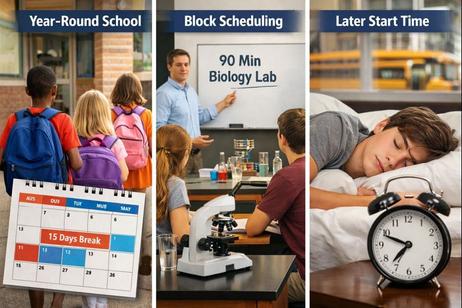
Learn how public school schedule options like year-round calendars, block scheduling, and later start times affect students and families in 2026.

Public School Schedule Options: Year-Round, Block Scheduling, Later Start Times — What’s Best for Your Family?

Public school schedule options play an increasingly important role in how students learn, how families plan their days, and how districts respond to academic and social needs. In 2026, school systems across the United States continue to experiment with public school schedule options designed to improve learning outcomes, student wellness, and operational efficiency.

For parents comparing districts or considering enrollment alternatives, understanding public school schedule options is essential. This guide explains three of the most common public school schedule options used today: year-round schooling, block scheduling, and later school start times. Each option affects academics, child development, and family life in different ways.

Why Public School Schedule Options Matter

Public school schedule options influence far more than bell times. Research shows that scheduling affects student attention, sleep, academic performance, teacher collaboration, and even transportation costs. According to the National Center for Education Statistics, U.S. public schools serve more than 49 million students, making scheduling decisions a nationwide concern with wide-reaching implications.
https://nces.ed.gov/programs/coe/

As districts adapt to post-pandemic learning gaps and workforce challenges, public school schedule options are increasingly viewed as tools for improvement rather than fixed traditions.

Year-Round Schooling as a Public School Schedule Option

Year-round schooling is one of the most debated public school schedule options. Despite its name, year-round schooling does not usually increase the total number of instructional days. Instead,

. . .read more

Public School Choice, Magnet Programs & Charter Options — What’s Best?

Updated
|
Public School Choice, Magnet Programs & Charter Options — What’s Best?
Explore public school choice in 2025: comparing magnet programs, charter schools and traditional public schools to find what’s best for your child.

Introduction

When families explore educational pathways, the phrase public school choice often emerges. In 2025, more parents, students and educators are asking: what is the right option — stay with a traditional neighborhood public school, apply for a magnet program, or consider a charter school? This article examines the core distinctions, benefits and challenges of public school choice, magnet programs and charter options, offers expert commentary and updates on current trends, and helps you determine what’s best for your child’s academic journey.

Understanding the Basics: What are the options?

Traditional Public Schools

A traditional public school is the default neighborhood school to which a student is zoned. It is directly managed by the local school district, accepts all students in its attendance area, and follows state-mandated curriculum and policies.

Magnet Programs

Magnet programs are schools of choice within the public school system that emphasise a specific theme — for example STEM, performing arts, world languages or gifted programmes. As one guide explains: “Magnet schools are free public elementary and secondary ‘schools of choice’ that operate within existing public schools in a district.”

Magnet programmes allow families to choose a school based on interest rather than geography.
Typically:

  • They draw students from across districts or large zones rather than strict neighbourhoods.

  • They may have themed curricula and offer enriched opportunities.

  • They are part of the public

. . .read more

How Much Homework Should You Expect in Public School

Updated
|
How Much Homework Should You Expect in Public School
Explore evidence-based guidance on homework loads in public schools—how much is healthy, how load shifts by grade, and how to spot when it’s too much.

How Much Homework Should You Expect in Public School?

Homework is a perennial concern for parents, students, and educators alike: too little and students may not get enough practice, too much and stress, burnout, or disengagement can follow. In 2025, the discussion continues—tempered by new research, evolving pedagogical strategies, and a growing focus on student well-being. In this article, we examine evidence-based guidelines, real-world patterns, and practical tips to help set realistic expectations for homework in public school settings.

Why Homework? Goals, Evidence, and Caveats

Homework is intended to reinforce classroom learning, build study skills, and foster independent learning habits. In practice, the benefits of homework vary significantly across age levels and assignment quality.

  • The “10-minute rule”, endorsed by the National PTA and the National Education Association (NEA), suggests assigning 10 minutes of homework per grade level (e.g. 20 minutes for 2nd grade, up to 120 minutes for 12th grade) as a reasonable upper bound (NEA).

  • A review of decades of studies found that in high school, 1½ to 2½ hours per night may yield positive returns; beyond that, additional time shows diminishing academic gains and heightened stress (Reading Rockets).

  • For elementary grades, research suggests minimal academic gains, with stronger benefits emerging in middle and high school (Edutopia).

These guidelines are useful, but they must be adapted to the

. . .read more

How Schools are Governed and Funded

Updated
|
How Schools are Governed and Funded
Explore the differences in governance and funding models between charter schools, traditional public schools, and private K-12 schools. Gain insights into how these factors shape educational experiences and outcomes for students.

As the education landscape evolves, it is essential to examine different schooling options and understand their strengths, weaknesses, and overall impact on students' educational experiences. In this article, we will compare three primary education models: charter schools, traditional public schools, and private K-12 schools, concerning governance and funding.

Charter Schools

Charter schools are publicly funded schools that operate under a charter or contract, which grants them increased autonomy and flexibility compared to traditional public schools. Individuals, organizations, or groups typically establish charter schools with a specific educational vision or focus.

Charter schools are independent public schools free to innovate while being held accountable for improved student achievement. They foster a culture of creativity, flexibility, and autonomy that allows teachers and school leaders to design and implement effective educational models tailored to the needs of their students. - National Alliance for Public Charter Schools

Governance Structure

Charter schools usually have their governing boards responsible for making important decisions regarding curriculum, budget allocation, hiring, and overall school policies. These boards can include parents, community members, educators, and experts from various fields. The thin governance structure allows for more localized decision-making. It promotes flexibility in responding to the needs of students and the community than is possible in an administration with more layers of management.

Flexibility in Curriculum and Management

One of the key features of charter schools is their flexibility in designing their curriculum and educational approach. Charter schools can develop specialized

. . .read more

Recent Articles

When “Free Public School” Still Isn’t Free
Discover the hidden costs of public school in 2026, from supplies and fees to transportation, technology, and extracurricular expenses.
What a District Budget Cut Means for Your Child's School Experience
Learn how district budget cuts can affect class sizes, programs, staffing, transportation, and your child's daily school experience in 2026.
School Closure Risk: What Parents Should Check Before Moving
Learn how parents can assess school closure risk before buying or renting in a district, using enrollment, funding, and boundary data.